
A bent leg, torn valance, or loose truss can take a tent out of service at exactly the wrong time. That is why a useful pop up tent review cannot stop at canopy color, advertised size, or the lowest purchase price. For rental operators, venues, caterers, schools, and event teams, the right folding tent must survive transport, frequent setup, changing weather, and repeated customer use while still presenting a professional appearance.
Pop up tents are valuable because they deploy quickly and work in locations where a larger frame tent is unnecessary or impractical. They are not interchangeable, however. A light-duty model may suit occasional shade at a small staff event, while a commercial-grade unit is a better fit for a rental fleet, vendor market program, or recurring hospitality operation. The difference appears over time in frame integrity, fabric performance, replacement-part availability, and labor costs.
A Pop Up Tent Review Starts With the Job
The first question is not which tent is best. It is what the tent needs to do. A 10 x 10 pop up tent used twice each summer for a registration table faces a very different workload than ten units moving through a rental warehouse every weekend.
For short-duration shade, check-in stations, concessions, merchandise, and vendor booths, a folding canopy can be an efficient solution. It packs into a manageable footprint, can often be installed by a small crew, and does not require the same transport and installation planning as a larger commercial tent system. Sidewalls can extend its usefulness for privacy, wind protection, branding, or light rain coverage.
The trade-off is that a pop up tent is still a temporary structure with operating limits. It should not be treated as a substitute for a properly engineered clearspan or frame tent when the event requires large guest counts, long-term installation, substantial wind planning, or a fully enclosed environment. Know the event scope before assigning equipment. Choosing the wrong category creates more cost and risk than choosing a higher-grade canopy within the right category.
Frame Quality Determines Rental Life
A commercial folding tent frame should feel stable before the top is installed. Examine the leg profile, truss design, connector points, footplates, and locking mechanisms. These components absorb the daily stress of loading, unloading, expanding, collapsing, and securing the tent at a site.
Aluminum frames are commonly selected for corrosion resistance and manageable handling weight. Steel-reinforced elements can add strength at high-stress points, but they may also add weight for crews. Neither material alone tells the full story. Tube thickness, truss geometry, joint design, and the quality of the hardware all affect how the frame performs after repeated cycles.
Pay close attention to the slider assemblies and the joints where the scissor frame opens. A loose or poorly aligned slider makes setup slower and can encourage crews to force the mechanism. That is how pins deform, brackets crack, and legs stop locking squarely. In a rental environment, a frame that saves two minutes on every installation can protect labor margins across a season.
Leg adjustment is another practical detail. Multiple height settings help teams level the canopy on uneven pavement or create useful clearance for guests and displays. The adjustment buttons should engage positively and be accessible without pinching fingers. Large footplates improve contact with the ground and provide a more secure point for anchoring.
Do not evaluate the frame only when it is new. Ask whether individual legs, trusses, feet, sliders, bolts, and pins can be replaced. A tent with available replacement parts may remain revenue-producing after a minor incident. A low-cost tent without parts support can become a complete write-off from one damaged component.
Setup Speed Is Only Useful When It Is Controlled
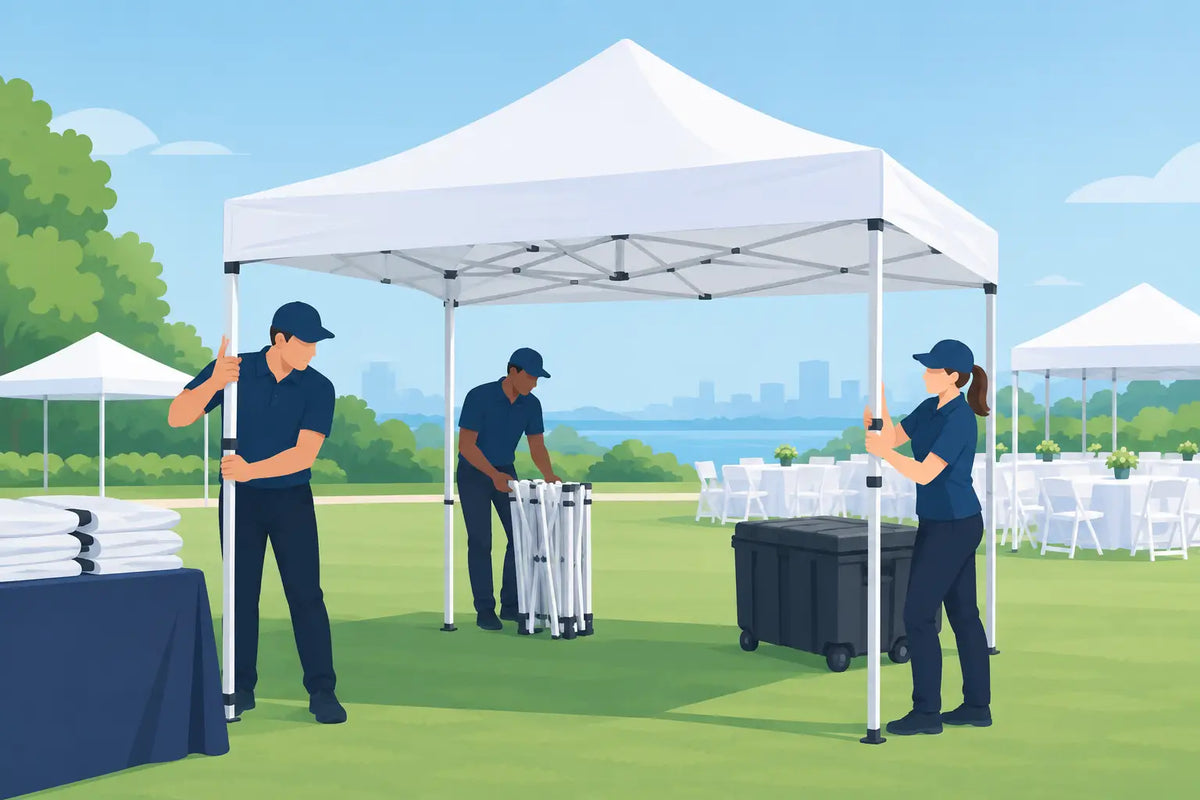
Fast deployment is a selling point, but it should never mean uncontrolled deployment. A reliable workflow has crews open the frame partway, attach or confirm the canopy top, extend the frame evenly, lock each corner, adjust leg height, and secure the unit before guests arrive. Rushing the last step is where preventable problems occur.
For a rental fleet, standardize setup procedures across staff. Consistent handling reduces uneven wear and makes it easier for returning crews to identify a missing pin, bent truss, or damaged top before the tent goes back out.
Canopy Fabric, Seams, and Sidewalls
The top is the most visible part of the tent, but its value is more than visual. Commercial canopies are often made from polyester with a protective coating designed to resist water and ultraviolet exposure. Fabric weight, coating quality, reinforced stress points, and seam construction all deserve inspection.
A water-resistant top may handle a brief shower, while a more thoroughly sealed canopy offers better protection during extended rain. Even then, water management matters. Tensioned fabric, a clean roofline, and proper pitch help shed water. Ponding water adds weight to the roof, stresses the frame, and can cause sudden failure if it is not cleared promptly.
Look at the corners and the areas around the frame contact points. Those are the places where fabric rubs and tension is concentrated. Reinforced patches and clean stitching are signs that the manufacturer has considered repeated deployment. Faded fabric may be a cosmetic issue at first, but brittle coating, seam separation, and pinholes are operational issues.
Sidewalls should match the tent size and attachment system. Full walls, half walls, window walls, zippered entry walls, and branded panels each serve different event needs. Rental operators benefit from stocking compatible wall options because a basic canopy becomes more useful across food service, ticketing, retail, and sheltered guest areas. Make sure wall attachment points are secure enough for normal use but simple enough for crews to install without delays.
Wind, Fire Ratings, and Site Conditions
No pop up tent review is complete without discussing conditions. Folding tents should always be anchored appropriately for the surface and forecast. Weight plates, stakes, ratchet straps, or other anchoring methods may be required depending on the site, local rules, and manufacturer guidance. A tent that looks stable in calm weather can become hazardous quickly when wind increases.
Never rely on the canopy frame alone for stability. Ballasting needs to be planned before equipment leaves the warehouse, especially for concrete plazas, parking lots, rooftops, and other locations where staking is not available. Build enough time into the load plan to move and position the required weights safely.
Fire certification is equally important for many professional applications. Venues, municipalities, exhibition organizers, and inspectors may require flame-retardant fabric documentation. Confirm that the tent fabric and any sidewalls meet the applicable requirements for the intended use, and keep documentation accessible with the equipment records. A suitable tent that arrives without the required paperwork can still delay an event.
Weather policies should be clear for both staff and customers. Heavy rain, strong wind, lightning, and snow load conditions may require evacuation, lowering the canopy, or full removal. Professional equipment reduces risk, but it does not eliminate the need for sound site judgment.
Compare Total Cost, Not Just Tent Price
The lowest-priced unit can be expensive if it needs frequent replacement or creates extra labor. A better purchasing review weighs purchase cost against expected deployments, repairability, setup time, available accessories, and replacement-part support.
For an operator building inventory, it is often smarter to standardize on a limited number of compatible sizes and frame grades. Standardization simplifies storage, sidewall matching, staff training, spare parts, and customer quotes. It also makes it easier to maintain a professional, consistent look across multiple event sites.
Consider the package as well as the canopy. A proper storage bag or roller bag protects the unit between jobs. Separate wall bags, labeled hardware containers, and dedicated weights help prevent missing components. A tent that is packed dry, cleaned after use, and inspected before reissue will last longer than one pushed wet into a truck after every event.
Buying for Operational Readiness
Before placing an order, confirm the deployed size, packed dimensions, clearance height, frame material, canopy material, included walls, anchoring needs, fire documentation, and replacement-part options. Also consider what your crew can realistically transport and set up. A larger or heavier frame may be the right long-term choice, but only if vehicles, storage, and labor plans support it.
Special Event Sales helps professional buyers source pop up tents alongside the sidewalls, weights, flooring, tables, seating, and event infrastructure that make a temporary setup ready for service. The practical goal is not simply to own more tents. It is to put dependable, compatible equipment into the field with fewer surprises.
The best tent for your operation is the one that fits the event, can be secured correctly, and returns from each job ready for the next one. Buy with that next deployment in mind.