
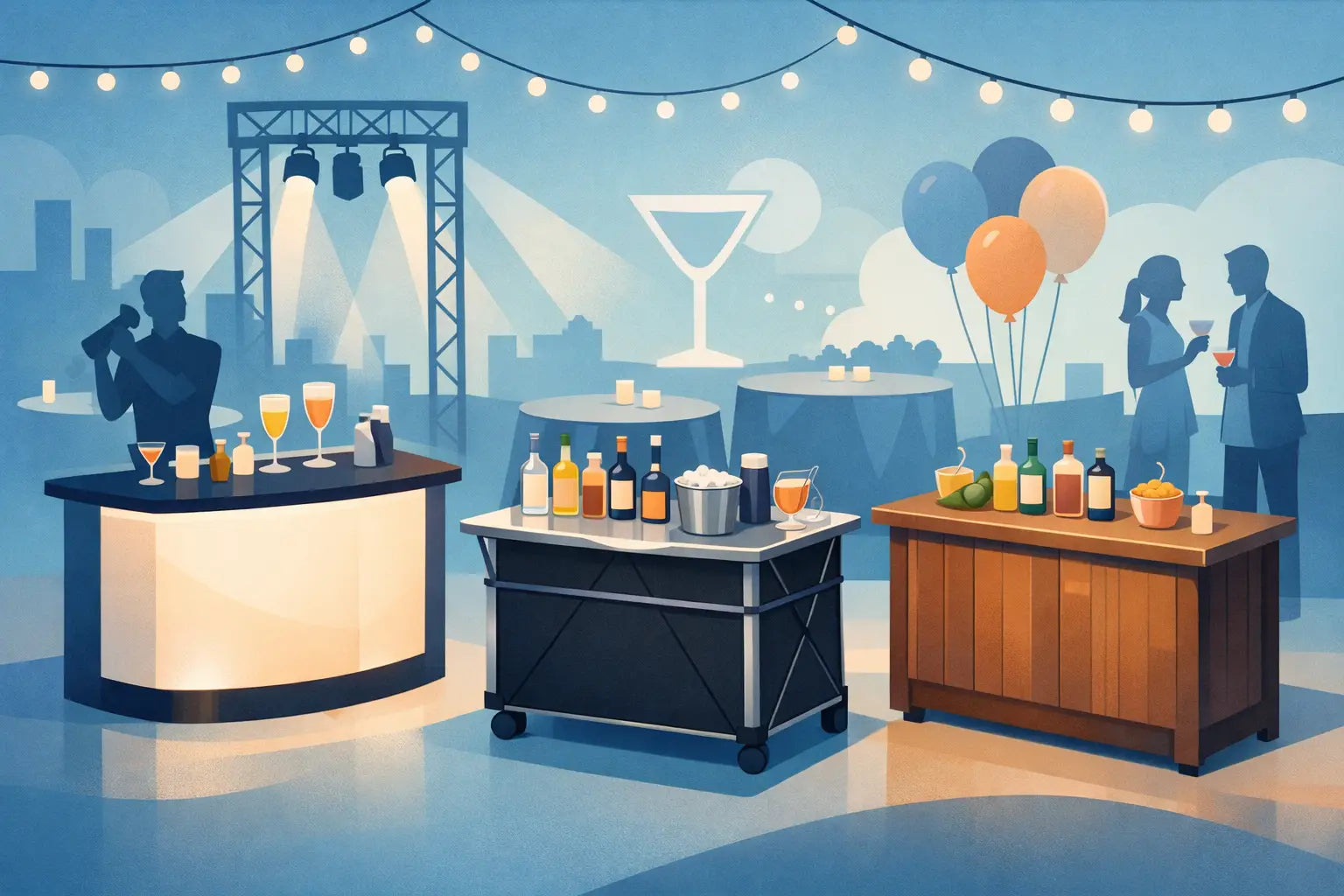
A portable bar can look excellent in a showroom and still become a problem on a Saturday night. If it takes too long to assemble, will not roll through a service corridor, or arrives without enough working surface, it slows down the crew and the beverage team. The best portable bar systems are built for repeated transport, quick deployment, polished presentation, and the real service demands of busy events.
For rental companies, caterers, hotels, venues, and mobile event operators, the right choice is rarely just the lowest-priced bar. It is the system that fits your truck, labor plan, event mix, storage space, and expected return on investment. A basic folding unit may be the right answer for occasional cocktail service, while a modular bar package can create a full service footprint for weddings, festivals, and corporate functions.
What Makes a Portable Bar System Worth Buying
Commercial portable bars need to solve two jobs at once: provide a guest-facing finished look and give bartenders a practical work area. That means evaluating more than the front-panel design. Look closely at the back-bar configuration, shelf placement, speed rail capacity, ice storage, waste access, and the space available for point-of-sale equipment.
Durability is equally important. Rental fleets should prioritize construction that tolerates frequent loading, unloading, cleaning, and assembly. Powder-coated steel frames, commercial-grade laminate panels, reinforced corners, locking hardware, and replaceable components all matter when equipment will be handled by different crews and sent to different sites every week.
Portability has several meanings. A lightweight unit may be easy for one person to move but too limited for high-volume beverage service. A larger modular system may require more handling, yet deliver better capacity and a stronger event presence. The best fit depends on whether your operation values compact storage, fast single-bar deployment, or the ability to build multiple layouts from the same inventory.
Main Types of Portable Bar Systems
Folding and Collapsible Bars
Folding bars are often the most efficient starting point for caterers, small venues, schools, and event companies that need a dependable serving station without a large transport commitment. These units typically open into a complete bar with a finished front and working counter, then fold down for storage and delivery.
Their advantage is speed. A trained crew can often place, level, and stock the bar with minimal assembly. They are also useful for satellite beverage stations, ticketed check-in areas, coffee service, or hospitality lounges. The trade-off is configuration flexibility. A folding bar generally has a fixed shape and footprint, so it may not adapt as well to large or unusually shaped service areas.
Modular Portable Bars
Modular systems are designed for operators who need more than one layout. Individual straight sections, corner units, returns, and back bars can be combined into L-shaped, U-shaped, curved, or long linear configurations. This makes them especially useful for rental companies, hotels, convention facilities, and production teams serving varied floor plans.
The commercial benefit is inventory efficiency. Instead of owning a separate bar for every event format, a well-planned modular package can be divided among several smaller events or combined for a major reception. Before purchasing, confirm how each section connects, whether finished ends are included, and how the components stack or cart for transport. A modular system that looks flexible but requires excessive loose hardware can add labor at every deployment.
LED and Illuminated Bar Systems
Illuminated bars create immediate visual impact for evening receptions, nightclub-style events, brand activations, and corporate galas. Translucent panels can be lit in coordinated colors, allowing the bar to become part of the event design rather than just a service station.
These systems require more planning than standard portable bars. Confirm power requirements, cable routing, replacement availability for lighting components, and whether the panels can be cleaned and protected during transport. For rental operations, standardized LED components and easily replaceable panels help keep the fleet serviceable. The visual premium can justify the added handling when the bar is a focal point, but it may not be necessary for every daytime banquet or high-turnover function.
Mobile Bars With Casters
A bar with heavy-duty locking casters is valuable when staff must reposition service quickly inside a ballroom, arena, patio, or tented event space. Casters reduce lifting and can speed room resets, but they are not a substitute for proper transport planning. Review wheel size, brake performance, overall unit weight, and whether the bar can safely cross thresholds, tent flooring seams, or uneven surfaces.
For outdoor work, larger wheels and a stable frame matter more than compact styling. A narrow mobile bar can be convenient in a back-of-house corridor but may feel unstable when fully loaded with ice, glassware, and bottled product.
How to Choose the Best Portable Bar Systems for Your Operation
Start with service volume. A bar serving 50 guests during a short reception has different needs than one serving 400 guests during a four-hour wedding. Consider the number of bartenders working simultaneously, the type of beverages offered, and how often restocking will be required. A good-looking front bar without enough rear storage can force staff to make repeated trips for supplies.
Next, measure your operational constraints. Record the dimensions of truck doors, elevators, storage rooms, loading docks, and common venue entry points. Check the weight of each component and decide whether your crews can safely handle it with existing carts and staffing. Equipment that is technically portable but difficult to move through your normal delivery path will create avoidable labor costs.
Then evaluate the finish against your customer base. Black, white, wood-look, stainless, and illuminated panels each serve different event styles. Neutral finishes usually generate the broadest rental demand because they work with corporate, wedding, hospitality, and municipal events. Specialty finishes can command higher rates, but they should be selected with clear demand in mind rather than purchased only for visual appeal.
Finally, consider serviceability. Ask whether replacement panels, hardware, shelves, and casters are available. In commercial inventory, small repairable issues should not take an entire bar out of circulation. This is particularly relevant for companies building a fleet intended to operate through peak wedding, festival, and holiday seasons.
Build a Complete Beverage Service Package
The bar itself is only one part of a productive service area. Pair it with compatible back bars, ice bins, speed rails, bus tubs, trash receptacles, beverage dispensers, stanchions, and appropriate flooring where needed. For tented events, a stable, level floor beneath the bar improves both appearance and day-to-day service safety.
For rental companies, package planning also improves upsell opportunities. A portable bar can be offered with bar stools, cocktail tables, lounge furniture, pipe and drape, dance floors, and lighting to create a more complete event environment. The goal is not to add equipment without purpose. It is to make the buyer's event easier to set up while increasing the value of each order.
Avoid Common Purchasing Mistakes
The most common mistake is buying based only on the exterior. Bartenders need an efficient station, not just a decorative counter. Review interior dimensions, storage access, prep surface, and how the bar functions when more than one person is working behind it.
Another mistake is underestimating transport protection. Finished bar panels can be damaged by loose hardware, stacked chairs, or shifting loads. Plan for padded covers, dedicated carts, secure tie-down points, and a storage method that keeps components organized. The cost of protection is often small compared with repeated repairs or a poor presentation at a client event.
It is also easy to purchase too much specialization too early. If your event mix is still growing, a durable modular system in a versatile finish may deliver a better return than several highly styled bars that only fit a narrow group of clients. Add specialty inventory when booking patterns show consistent demand.
A portable bar should help your team serve faster, transport smarter, and present a professional beverage experience at every event. Select the configuration around your actual service requirements, then build the supporting equipment package that keeps it working profitably from one booking to the next.