
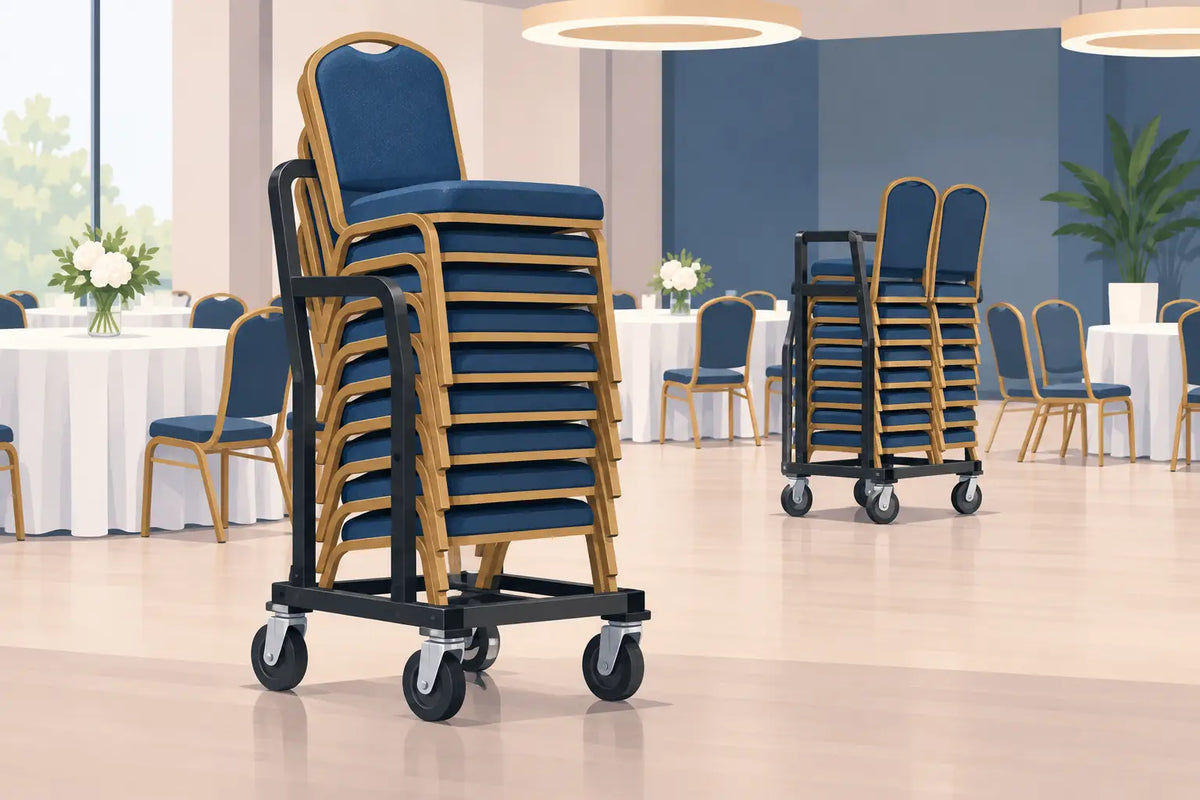
A chair dolly earns its place when a crew has 300 banquet chairs to clear before the next room flip. The best banquet chair dollies reduce handling time, protect chair frames, and keep stacks stable from storage to loading dock. For rental operations, hotels, caterers, schools, and venues, the right cart is not a minor accessory. It is part of the labor plan.
The best choice depends on the chair style in your fleet, the number of chairs moved per trip, and the conditions between storage and setup. A high-capacity dolly that fits one chair profile perfectly can be a poor investment if it cannot safely handle the other chairs your crews use every weekend.
What Makes the Best Banquet Chair Dollies Different
Commercial chair dollies are built around a simple job: move stacked chairs without forcing staff to carry them individually. But the details determine whether that job is actually easier. Frame geometry, wheel type, stack capacity, and loading direction all affect daily performance.
A properly matched dolly supports the chair stack at its strongest points. It should hold chairs upright and centered without squeezing upholstery, scuffing powder-coated legs, or allowing the stack to sway over thresholds. When the cart is too wide, too narrow, or designed for another chair profile, crews compensate by loading fewer chairs or moving more carefully. That erases the productivity benefit.
The frame also needs commercial-grade construction. Event equipment sees repeated impacts from doorways, truck ramps, pavement joints, and storage racks. Look for welded steel construction and a finish that resists chips and corrosion. Bolted components can be useful where serviceability matters, but they should be substantial and easy to inspect.
Start With Chair Compatibility, Not Capacity
Capacity gets attention because it is easy to compare. Compatibility should come first. A dolly rated for 25 chairs only delivers that capacity when the chairs stack in the intended orientation and the cart supports the stack correctly.
Measure the outside width and depth of a nested chair stack, not just a single chair. Consider the chair's leg shape, under-seat bracing, back profile, and whether it has a fabric or vinyl seat. Banquet chairs with different frame dimensions may look interchangeable from across the room but nest very differently on a cart.
Stackable banquet chairs
Standard stackable banquet chairs often work best with upright dollies that cradle the bottom of the stack and provide a tall back or retaining frame. These are a practical choice for venues and rental fleets using matching steel-frame chairs in volume. The upright design keeps the load compact and makes it easier to navigate aisles, elevators, and staging areas.
Confirm whether your chairs must face one direction on the dolly. Some models load consistently only when every chair is oriented the same way. That is manageable in a controlled warehouse, but it can slow crews during teardown if the process is not clear.
Folding chairs and specialty seating
Do not assume a banquet chair dolly will work for folding chairs, resin chairs, cross-back chairs, or other specialty seating. These products need carts designed around their folded dimensions and weight distribution. A universal cart can sound appealing, but it often carries fewer chairs and offers less protection than a dedicated model.
For a mixed rental inventory, it can be more economical to standardize on a few dollies matched to your highest-volume chair categories. This limits loading errors, helps crews move faster, and avoids damage claims caused by improvised transport.
Choose a Capacity That Fits Your Operation
Higher capacity reduces trips, but the largest possible load is not always the most efficient load. A fully loaded chair dolly may be difficult to turn in a narrow ballroom corridor, control on an incline, or lift over a trailer ramp transition. It may also exceed what one crew member can safely handle.
Think about the complete route. Measure door openings, storage aisles, elevator access, ramps, truck interiors, and the distance from unloading to the event floor. A 20- to 25-chair capacity may suit a large warehouse and direct truck loading. A more compact cart may be the better choice for a hotel property with tight service hallways and frequent room changes.
Weight matters as much as chair count. Multiply the chair weight by the intended stack quantity, then add the dolly's own weight. This gives a realistic loaded weight for staffing, ramp selection, caster selection, and safe movement policies. Published chair capacity is useful, but it should not replace a practical load assessment.
Wheels Determine How the Dolly Performs
Caster configuration has a direct effect on maneuverability and maintenance. The floor surfaces your crew crosses should guide the decision.
Hard rubber or non-marking casters are often appropriate for finished venue floors, banquet halls, and back-of-house corridors. They can provide quiet operation and help reduce the risk of floor marks. Pneumatic wheels can be useful where carts regularly cross rough asphalt, gravel, uneven loading areas, or outdoor event grounds, although they require inflation checks and are more vulnerable to punctures.
Swivel casters improve turning in tight spaces, while fixed wheels help a loaded dolly track straight over longer distances. Many crews prefer a combination of both. Larger wheel diameters generally handle thresholds and rough transitions better than small casters, but they can increase the cart's footprint and cost.
Brakes are worth considering when the dolly is used near ramps, sloped loading areas, or busy staging zones. A parked stack of chairs can become a safety issue quickly if it rolls during loading or unloading.
Protect Chairs, Floors, and Crew Time
A chair dolly should reduce damage, not concentrate it. Look closely at the contact points where the chair stack rests against the cart. Protective rails, smooth support surfaces, and proper spacing can prevent scratches to chair frames and tears to upholstery. If your rental fleet includes premium seating, this detail has a direct effect on refurbishment costs and appearance at the next event.
The same principle applies to flooring. Non-marking wheels matter in hotels, convention facilities, schools, and polished concrete venues. If chairs are routinely transported across carpet, make sure the cart rolls easily under load rather than sinking or dragging. A dolly that works well on warehouse concrete may perform poorly on dense carpet or temporary event flooring.
Ergonomics deserve equal attention. Handle placement should allow staff to push or pull without bending awkwardly, and the loaded stack should remain stable when changing direction. Train crews to keep loads within the cart's rating, move at a controlled pace, and use two people where routes include ramps, uneven terrain, or heavy stacks.
Plan for Storage and Transport
Chair dollies occupy space even when empty. Before purchasing, account for the cart's parked footprint, turning radius, and whether it can be stored vertically or nested with other carts. This is especially relevant for venues with limited back-of-house storage and rental companies managing seasonal inventory.
For truck-based operations, verify the dolly height with a full chair stack. It must clear the truck opening, interior roof, and any shelving or e-track system. Also consider how dollies will be secured in transit. A loaded cart should be blocked and tied down so it cannot shift, roll, or transfer force into the chair stack.
Replacement wheels, caster hardware, and protective components are also part of ownership. Equipment that runs several events each week will eventually need service. Selecting a commercial dolly with accessible components can keep a minor repair from taking a needed cart out of rotation during peak season.
A Practical Buying Approach for Chair Fleets
For a new venue or expanding rental inventory, purchase chairs and dollies as a system. Confirm the exact chair model, stacking direction, loaded height, and cart capacity before placing the order. If you already own chairs, share accurate dimensions and photos with an equipment specialist rather than relying on a general product category.
At Special Event Sales, professional buyers can source chairs, storage carts, and the broader event infrastructure needed to keep equipment moving from warehouse to venue. That category-level approach matters when a chair purchase also affects truck packing, storage layout, staffing, and replacement-part planning.
The best banquet chair dollies are the ones crews can load without thinking, roll without fighting, and rely on through a full event season. Match the cart to the chairs and the route it must travel, then let every room flip take fewer hands and fewer trips.